
Two things I’ve noticed about getting older:
- The longer you live, the bigger the chunks of time you are able to see at a glance. It’s like rising higher and higher in a hot air balloon, which enables you to visually take in more terra firma before the horizon puts a frame on it.
- The more you look, the more you notice that there is very little new under the sun. Things you see from your elevated vantage point form patterns, and at first you want to tell people about them as if you are the first person to ever notice such things. But even a cursory review of history and the observations of previous balloon goers quickly disperses this idea. The stuff on the surface of the land may change into newer form, but the topography remains the same.
One of the things that I struggle with more and more, especially on bad days, is the feeling that an unhealthy percentage of what passes for culture in my country consists of things I personally consider unbelievably vapid, hollow, and superficial. Leaving the house, I can go anywhere where people tend to congregate in numbers, and I am left with this feeling that I am walking or driving through that scene in Blazing Saddles where the caravan of bad guys are riding through the replica town which was actually a trap set by the good guys, and when they figure it out, Slim Pickens yells “It’s a Fake! We been suckered in!” right before the shooting starts.
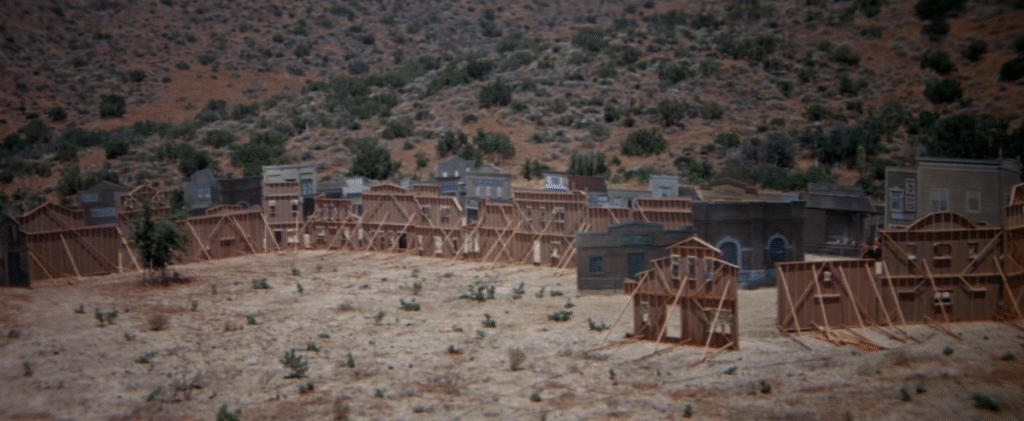
When we are watching that scene, it seems ridiculous because the building fronts of the town obviously have nothing behind them; they are empty facades whose doors and windows are blind alleys leading nowhere. We find the scene funny because it’s so preposterous and so transparent: how could anybody ever take this array of obviously propped up facades standing open for anyone to see in the middle of the desert seriously? And yet the posse of bad guys are so addled and myopic and beset with such tunnel vision that they fail to notice any of this and just ride hell bent for leather right into it in complete earnest.
Lately, I get this feeling a lot while driving down roads in my town that are populated by businesses on both sides. I’m surrounded by billboards and signs in front of each one, each designed to grab my attention before I pass it and draw me in, as though each one were written in ALL CAPS and had an exclamation point after the name of the establishment: JACK IN THE BOX! SPEEDWAY! MOTEL 6! MCDONALD’S! KFC! COSTCO! CHICK-FIL-A! I try not to look, but the fact that I am able to not only list these facades I encounter every Saturday morning on my weekly trip to buy groceries, but list them in order of geographical occurrence, means that the exclamation points and their makers are getting through my defenses as intended in spite of my best efforts. Not to mention the fact that the irony of my actual destination being the second to last of the facades on the aforementioned list is not in the least lost on me.
Irony notwithstanding, part of my armor, my defense mechanism against this weekly assault, is the habit of giving the whole thing a private nickname that makes it at least a bit more palatable. This doesn’t happen consciously, at least that I am aware of. These little nuggets of attribution just seem to swell up like some subconscious water balloon filling slowly at the kitchen sink until at some point they burst forth in full soaking splendor as a thought that, once seen, cannot be unseen. In the case of the business facades on my shopping road, my brain irrevocably reduced them to the following words, “BIG SHINY”, which seems to encapsulate everything the experience is about, both in terms of the individual establishments themselves and also what they collectively represent. That the acronym for these words happens to be “BS” I take as a small gift from whatever higher power a good agnostic like myself allows recognition of. 1
It is tempting to think that the big difference between the Blazing Saddles – which, curiously, also reduces to the acronym BS – replica town scene and the modern BS is that the facades in the movie have nothing behind them but buttressed two-by-fours holding them up, while the buildings in the current BS are actual business establishments. It is further tempting to see this as a metaphor for the emptiness of the promise of the businesses of the current BS. But while in one sense that metaphor holds some indeterminate amount of water, it’s not by any means the end of the story, because there is a lot more behind those buildings that a bunch of diagonal two by fours.
What’s behind those facades is not just a corporate machine, but a national ideology that has arguably become something akin to a religion. This ideology, once known as the pursuit of happiness, has somehow transmogrified into the divine right of people to try to sell you stuff you don’t really need, 24/7/365, whether you want to listen to them or not. (This is clearly too long to be reduced to an acronym, but in a pinch, “SYS24/7” might suffice)
The mechanism involved is at once incredibly complicated, and also incredibly simple:
- The first step is to make us all forget what happiness actually is.
- The second step is to replace it with something far more easily attained.
- The third step is to surround us with an infinite array of these happiness substitutes at all times and tout our freedom to choose from among them. 2
- 1) Make us all forget about what happiness actually is.
There are a lot of ways to define happiness, and many different shades of it, which is part of what makes it easy to make us forget what it actually is and why it’s so important that the founding fathers saw fit to put the pursuit of it as a central tenant in our founding documents. For the sake of simplification, let’s describe the two poles of happiness and then ask ourselves the following question: Which of these two extremes do we think is the more important meaning of the word “happiness”?
Big Picture, Long Term Happiness: The kind that comes from being free to choose and pursue one’s own goals, work toward attaining them, and then decide how these goals fit into the overall framework of making a living and surviving in the world we live in. For some people, this formula may be simple if the intrinsic goal is along the lines of, “I want to be a doctor, and I happily accept the hardships involved in attaining that goal in order to enjoy the lifestyle that generally goes along with it.” Implied in this statement is the understanding that it will involve many years of education and training, expense, singular commitment, residency, etc., and then at the end of it the person who has made it that far will have ample opportunity for employment in most places and a comfortable income as compared to many if not most other professions. The person who attains this goal has every opportunity to be happy, not only with the financial and social class they have entered and all that comes along with it, but also with the satisfaction of knowing that they have worked hard and paid their dues in order to be where they are.
For others, the formula is a bit more complicated because the goal they wish to pursue is not inherently a lucrative one that is easy to support oneself (let alone a family) with as a sole means of income. By way of example, 95% of the best jazz musicians I know, all top flight artists, make the majority of their income by some means other than playing music. Most are teachers, but among other income earning examples I have seen everything from museum curator to administrator to online IT specialist to lawyer to optician and more as the primary occupation providing the main source of income. In spite of this, I would describe the vast majority of these people as happy in the overall sense because they have worked just as hard as the doctor (if not, in some cases, harder), and have managed to emerge with a way to make a living for themselves and their families and also to practice their craft, about which they are passionate.
There is another category of people who, to put it as plainly as possible, just want to be able to support themselves and their families as best they can. They may or may not have an overriding passion for some craft or activity, but their primary concern is just surviving in a world that doesn’t seem to concern itself with their personal passions, hopes and dreams. Happiness, then, is survival and staying afloat and making the best of an imperfect world, with the hope that, though they might not be passionate about the nature of their employment, it will provide enough income that the bills will get paid and they can use whatever is left over for whatever things they find enjoyable.
It’s also worth noting that these categories easily overlap and bleed into each other. But what they share is that basic happiness is defined as an ongoing, lifetime pursuit rather than a moment-by-moment assessment.
Short Term, Temporary “Reprieve-From-Psychic-Boredom” Happiness: The term “psychic-boredom”, as used here, denotes the state in which the human brain is troubled by not having continuous input. Without something to occupy itself, the mind can and often does spin toward all manner of dark and disquieting places. For many people, the most disturbing thing the mind can encounter is silence, the mental equivalent of nothingness. Rather than face this void, the mind often hastens to fill it with whatever is closest at hand, which all too often includes thoughts of doubt, uncertainty, insecurity, and fear.
Every single person I know has expressed experiencing some version of this basic human phenomenon: upon waking in the night, you know you need to go back to sleep, but your brain keeps peppering you with thoughts of things you need to do, mistakes you worry you have made, things that might go wrong, the fact that if you don’t get back to sleep soon, you’ll likely go through the next day exhausted from sleep deprivation, etc. It’s such a universal experience that everyone I’ve ever met knows about when the subject comes up. When this same scenario starts to play itself out while we are fully awake during our daytime hours by virtue of having nothing meaningful to focus on, it is even more disturbing. Because the idea that sleep at night, if we can only sink back into it, would make all of this entropic chaos go away, but this is no time for sleep. And the natural inclination is to find something, anything, to fill that void. The basic instinct then, becomes “any port in the storm”.
2) Replace actual happiness with something far more easily obtained.
In this light, which of these two forms of happiness seems the more important one to pursue?
Because actual happiness is hard and always a work in progress, it can’t be bought or sold. Rather, it must be earned. Sure, the BS can and does try to sell you stuff (SYS) to help you achieve these long term goals, but the market for tools – things that actually have a specific purpose to a specific professional end – is laughably tiny compared to the market for momentary distraction from the terrifying entropic chaos of what’s in your head when you find yourself without something to do or something to think about for even 30 seconds. Or less: how often do we see people pulling out their phones while sitting at a stop light, and crawling into them to the point where the driver behind them has to honk when the light turns green? These days, this habit seems to be on its way to becoming more the norm than the exception. What the BS knows all too well, and what most of us know on some level, is that our need for distraction is greater than our will to endure contemplating actual reality for more than a few seconds, because we have forgotten how to simply be. And since the BS is all about directing attention to itself so it can try to sell us stuff we don’t really need, our attentional door is open to pretty much anything that is more attractive to the void-avoiding brain than a few seconds of silence. In other words, just about anything but that will suffice, which makes “replacing happiness with something more easily obtained” akin to shooting fish in a barrel.
If this is what we have allowed to be called happiness, then we have failed miserably in many ways. What we now pursue is relief from the responsibility of actually considering what true happiness is. And we get this relief from whatever distractions we can beg, buy, borrow, or steal that help us to forget this most basic idea, the idea that true happiness is hard, that it is a lifelong process, and that it takes a lot of work and effort to achieve. Since that so often seems too much to face, we resort to things like social media and “reality” TV.
- 3) Surround us with an infinite array of these happiness substitutes at all times and tout our freedom to choose from among them. The complicated thing about Freedom is that it comes in two colors: Freedom to, and Freedom from: Freedom from oppression, and Freedom to choose. This distinction is, as the great 20th century philosopher F. Vincent Zappa so eloquently put it, “the crux of the biscuit”.
At this point, we are certainly free to choose between Apple and Android, Crunchy or Smooth, Google or Google, Facebook or X or Tiktok or Insta, etc. We are free to choose to buy stuff in person from an actual store, or online, or buy it from a real store and have it delivered. We are free to choose between eating processed foodlike products, or eat actual food that grows naturally on the planet. We are free to watch and listen to forms of media and art that are designed to challenge us and make us think, or forms of media designed to keep us from thinking by being predictable and unchallenging. We can choose to fill whatever free time is left over after we have earned our daily keep however we want, and this is entirely as it should be.
But freedom to is balanced by freedom from. By way of example, you are not free to choose breathing clean air in a sandstorm, or free to stay dry in the middle of a flood. And if we’re being honest, the current environment feels a bit like an assault of nonstop distractions from all sides. Sure, we are free to willingly ignore them, but that’s not as easy as it sounds, because they are literally everywhere. Ever try to find a healthy meal within shouting distance of an interstate exit, or to shop at any store of any type without being bombarded with mind numbing Muzak? If the only choices we seem to have are pre-chosen by the BS, are they really choices?
The current online culture is often described as an attempt to “drink from a firehose”. But as if that weren’t bad enough, now imagine that 98% of what’s coming though that firehose is poison, and the other 2% is water. That makes it much more difficult to choose, no? Yes, we can still do it. Sort of. But no, it isn’t easy.
Ultimately, the choice is still ours, and rather than moralize about which choices are right or wrong, or better or worse for both each of us and the society we all inhabit, it might be more useful and more personal to phrase this point as a question: When each of us is near the end our time on the planet and we are looking back at the choices we made along the way, what do we think we will feel about those choices? And does this seem like an important point?
If so, then the answer to this question may give us all some guidance moving forward. So whatever we do, we should pick our poison with intent. Make sure that when we find ourselves near the end of the road, 20 or 40 or 50 years from now, or whatever fate holds for you, we don’t find ourselves saying “I wish I would have _____ while I still had the chance”. Because now – RIGHT now – is that time and that chance. Choose wisely.
1 My favorite greeting card of all time, which I randomly found in a Target store years ago, shows a cartoon of two women with speech bubbles. On the front, the woman on the left is saying “Where’s your birthday party at?”, to which the woman on the right replies “Never end a sentence in a preposition”. Open the card, and it’s the same picture, with the woman on the left now saying, “Where’s your birthday party at, Bitch?” So it’s clear that even the ad men behind the scenes at the BS get off a good one now and again.
2 My favorite SNL sketch of all time was a self-referential takedown on R&B video culture called “D*ck In A Box”. In a straight faced musical presentation, Justin Timberlake and Andy Samberg sing about surprising their attractive female partners by placing their genitalia in giftwrapped boxes attached to the front of their trousers, then getting their partners to open the “gifts”. At one point, there’s a bridge in the song where the following lyric occurs: “ONE…cut a hole in the box. TWO…put your junk in that box. THREE…make her open the box. That’s how you do it”. Since viewing that sketch, it has become impossible for me to read of any three-step process without this image coming directly to mind. Proving yet again, as if any proof was needed, how powerful and pervasive the BS can be at placing indelible images in the brain.
Leave a Reply